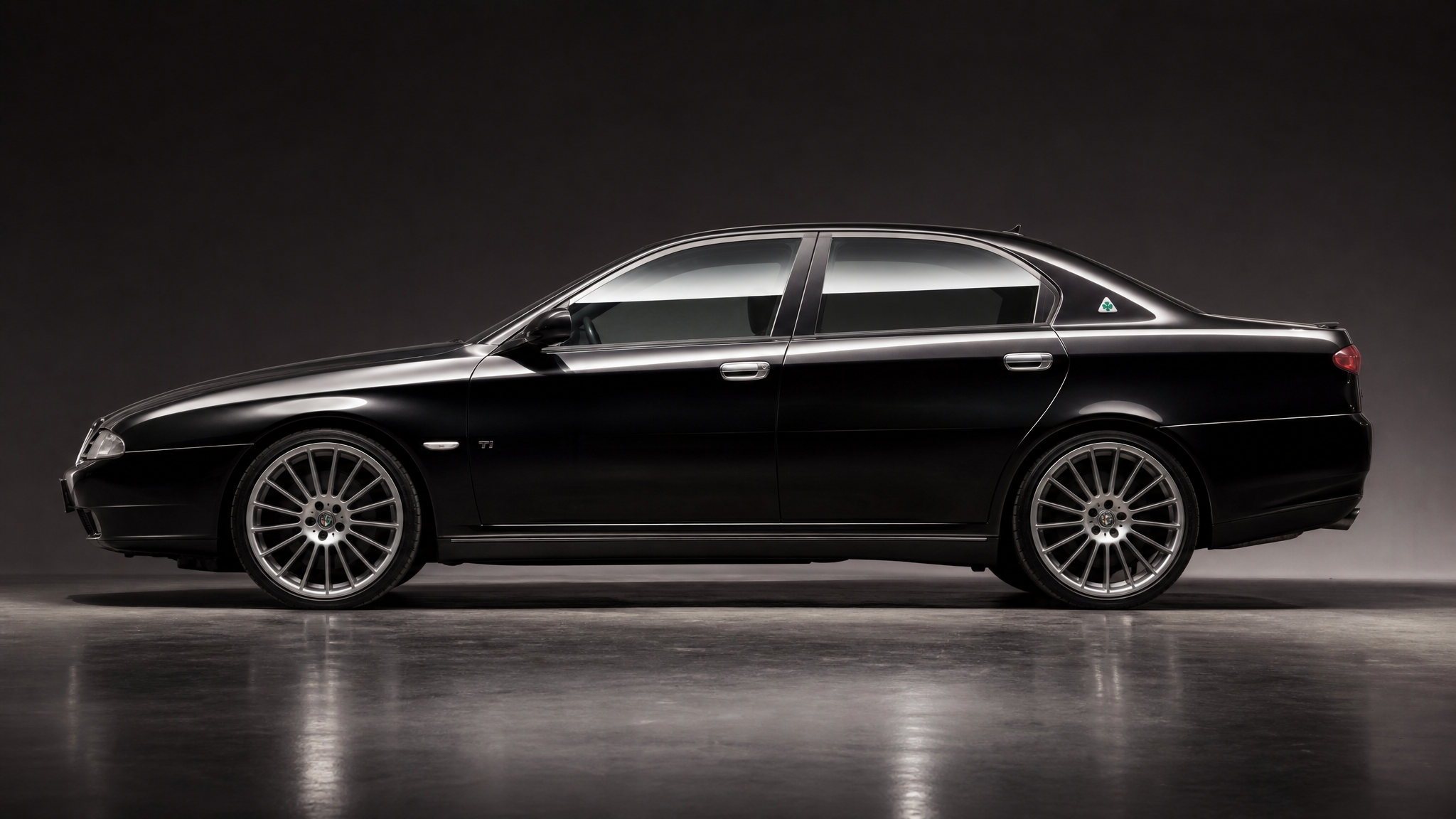
Storia VI — Il grande incompiuto
Alfa Romeo 166 (1998–2007) — the flagship that was meant to be more
Cuore Sportivo — the "Souls and Hearts of Alfa Romeo" series, Storia VI. Alfa Romeo 166 (1998–2007) — the flagship that was meant to be something more.
Arese · nine years, two series, one car alfisti still argue about over espresso.
I bought her knowing she wasn't perfect. That, I think, is the only sensible way to buy a 166.
Because this is not a car you buy out of reason. Reason leads you, in the E-segment, to the Mercedes showroom, to the Audi A6 or the BMW 5 Series — cars that, even after twenty years, close their doors with the same dull, precise sound they learned in Ingolstadt. The 166 closes its doors differently. Warmer. More metallic. A little less certain. And that, to my own surprise, is the difference for which I chose this car.
Il ritardo
The 166 arrived four years too late. The muletti — the prototypes — were running around Arese as early as the mid-nineties, but Alfa Lancia Industriale launched the 156 first, because it made more strategic sense by volume. The result: the 164 stayed in production for eleven years — five too many — and the 166 debuted in 1998 into a market that had already moved on to other expectations. Electronics, ergonomics, the quality of materials in the touch zones — the Germans had raised the bar another notch before the Italians even reached the starting line.
Over nine years of production (with a 2003 facelift) Alfa sold a little over 100,000 units — most of them in Italy. By comparison, the 156 was a success beyond the peninsula too. The 166 was never accepted as a European flagship. It was a project that lost before it ever reached the streets.
Il telaio — where the 166 wins
And here is the first paradox: mechanically, the 166 is one of the better cars of its class in that decade. Not "quite good for an Alfa" — simply good.
The front suspension is a high quadrilatero (double wishbone) — the same philosophy that built the driving reputation of the 147/156/GT trio. The rear — a multilink deliberately designed so that the rear wheels steer in counter-phase to the fronts, minimally, electronically linked to speed and steering angle. The effect: the 166 turns in faster than its 1.5 tonnes of mass and front-wheel drive should allow. It changes direction with a lightness the BMW E39 doesn't have, even though the BMW is rear-driven and better balanced.
The precision of the suspension also lets Alfa do something the German competition doesn't — choose a relatively soft calibration of springs and dampers without losing driving precision. The 166 can be comfortable at motorway pace and sharp in the Italian Alps on the same journey. That is a rare skill.
It has no rear-wheel drive. But — as Motor1.it aptly puts it — that absence would only sting if there were a 400-horsepower, M5-style version. There isn't. So it doesn't.
I motori — the last word of the Busso
The petrol engines split into two worlds. One — the 2.0 Twin Spark 16V, 155 hp, correct but without a flagship's character. It's an engine for fleet buyers, for the lawyer who has to have "something of an Alfa" but doesn't want to pay for the V6.
The other world is the three V6 Busso variants — the last use of this engine in an Alfa flagship:
- 2.0 V6 Turbo, 205 hp — SOHC, two valves per cylinder, the last turbocharged Busso, withdrawn at the end of 2000 because it no longer met the new emissions standards
- 2.5 V6 24V, 190 hp — aspirato, DOHC, refined and flexible
- 3.0 V6 24V, 226 hp at 6300 rpm, 270 Nm at 5000 — the flagship unit, about which I've already said everything in Storia V
After the 2003 facelift, the Busso family delivered its final word in the 166 — the 3.2 V6 24V with 3179 cc displacement and 240 hp at 6200 rpm, producing 289 Nm of torque at 4800 rpm. It was the largest Busso ever fitted to a production Alfa flagship — previously used in the 156 GTA and 147 GTA (there rated at 250 hp). To accommodate the increased capacity, Alfa rewrote the ECU software, upgraded the cooling system with an additional engine oil radiator, and retimed the intake and exhaust ports. The result: 0–100 km/h in 7.4 seconds, top speed of 245 km/h.
But the most distinctive detail was the transmission decision: the 3.2 V6 24V was available exclusively with a 6-speed manual gearbox. No Sportronic option. No alternative. Alfa deliberately decided that the most powerful Busso in the 166 belonged to drivers who wanted to drive — and to them alone. For today's collector, it stands as the last Alfa Romeo saloon in which one could have both the largest Busso and a third pedal. After it — never again.
Then the 2.4 JTD diesel, an inline five (the same one as in the Lancia Kappa and Thesis), developed over the years from 136 through 140 and 150 to the final 185 hp in the Multijet version after the 2003 facelift. It was the best-selling engine in the range. Until 2003 it was available exclusively with a 6-speed manual — the absence of an automatic for the diesel was one of the decisions that cost the 166 thousands of unsold units in France, Germany and Scandinavia. Only the 2003 facelift introduced the optional 5-speed Aisin AW 50-5ECT-i automatic for the 2.4 JTD 20V Multijet — but by then it was too late to reclaim the markets Alfa had lost to the German flagships.
Il paradox degli interni
The 166's interior is one of the most beautiful designed in the European E-segment of the nineties. Enveloping, elegant, modern without trying to imitate a Boeing cockpit. Materials in visible places — very good. Momo leather in the Sportronic version, aluminium trim, wood in the Lusso versions.
But the build quality and the durability of materials in the touch zones — that is the 166's second paradox. The steering wheel begins to wear after two or three years. The gear knob loses its factory finish. The driver's seat gives way well before a hundred thousand kilometres. These are things that simply don't happen in an Audi A6 of the same generation.
The electronics were below the level of the competition, and that shows too. Alfa found space for the navigation screen "at the last minute", when it realised at the end of the nineties that you could no longer sell a flagship without one. The solution works, but not in the way German navigation systems work.
TI — Turismo Internazionale
With the 2003 facelift, the 166 gained a version bearing one of the most historic designations in Alfa Romeo's vocabulary: TI, Turismo Internazionale.
Alfa used this two-letter mark sparingly — only in moments when it wanted to emphasize the sporting-touring character of a specific version. Giulia TI in the 1960s. 159 TI in 2007. Between them — 166 TI. Each time the meaning was the same: not a full sport variant (QV and GTA existed for that), but a version for the driver who wants more dynamics without giving up flagship comfort. Turismo Internazionale — a way to travel international roads, not to circle a track.
The TI package gave the 166 a sportier character, including: lowered sport suspension, 18-inch alloy wheels, black leather sports seats and distinctive TI badging on the sills and inside the cabin.
For today's collector, the 166 TI is the most sought-after version of the entire range — not only because it is rare, but because the TI mark places it in line with the Giulia TI of the 1960s and the 159 TI of the last Alfa generation with a Busso under the hood. Three TIs, three eras, one philosophy.
Perché la scelgo oggi
I knew all of this before I bought her.
I bought her anyway, because in 2026 all those flaws become virtues. There are no more 166s whose interior looks perfect — but there are those that have aged with dignity, into which someone has put their heart, where the steering wheel is already a little patinated by the hands of previous owners. This car has character acquired through use, not from factory imperfection.
And under the bonnet it has the last Busso V6 in the E-segment. That won't come back. After the 166, Alfa switched to a V6 from Holden, and this whole history — from Giuseppe Busso's designs of 1979 for the Alfa 6, through the GTV6, the 164, the 156 GTA, all the way to my own Sportronic — ends in 2007, when the last 166 rolls off the line at Arese.
I chose her because she is il grande incompiuto — the Great Unfinished. A car that was meant to be a European flagship and became an Italian collector's piece. I don't regret the exchange. On the contrary — I think there is a kind of poetry in her that no perfect German saloon of that decade has.
The 166 didn't win the war of the spreadsheets. But when I fire her up on a frosty morning, I hear under the bonnet a sound no Mercedes ever made.
And that is enough for me.
Alfa Romeo 166 — engines (1998–2007)
| Version | cc | Power | Valvetrain | Notes |
| PETROL | ||||
| 2.0 Twin Spark 16V | 1970 | 155 hp | DOHC 16v | 4-cyl, 2 plugs/cyl |
| 2.0 V6 Turbo | 1996 | 205 hp | SOHC 12v | withdrawn 2000 (emissions) |
| 2.5 V6 24V (Busso) | 2492 | 190 hp | DOHC 24v | aspirato |
| 3.0 V6 24V (Busso) | 2959 | 226 hp | DOHC 24v | aspirato, optional Sportronic ZF 4HP20 |
| 3.2 V6 24V (Busso) | 3179 | 240 hp | DOHC 24v | from 2003 facelift, exclusively 6-speed manual |
| DIESEL | ||||
| 2.4 JTD 10V | 2387 | 136–150 hp | SOHC 10v | inline-5 |
| 2.4 JTD 20V Multijet | 2387 | 175–185 hp | DOHC 20v | post-2003 facelift, optional 5-speed Aisin AW 50-5ECT-i |
This story is part of the Busso family, which I cover more fully alongside the Alfa Romeo 166 project — there you'll find the V6 from my 166 in detail. On how it sounds next to the boxer from the 33, I write in Storia V: Due voci.
Cuore Sportivo — because numbers alone never made anyone fall in love with a car.
About this article
I bought her knowing she wasn't perfect. The story of a great ambition that stalled halfway — and defends itself today, even so, as a car of passion. Il grande incompiuto.