Storia V — Due voci: The 1.4 8V Boxer Meets the Busso V6 3.0
Pomigliano and Arese in one garage — the two poles of Alfa's character
By Admin
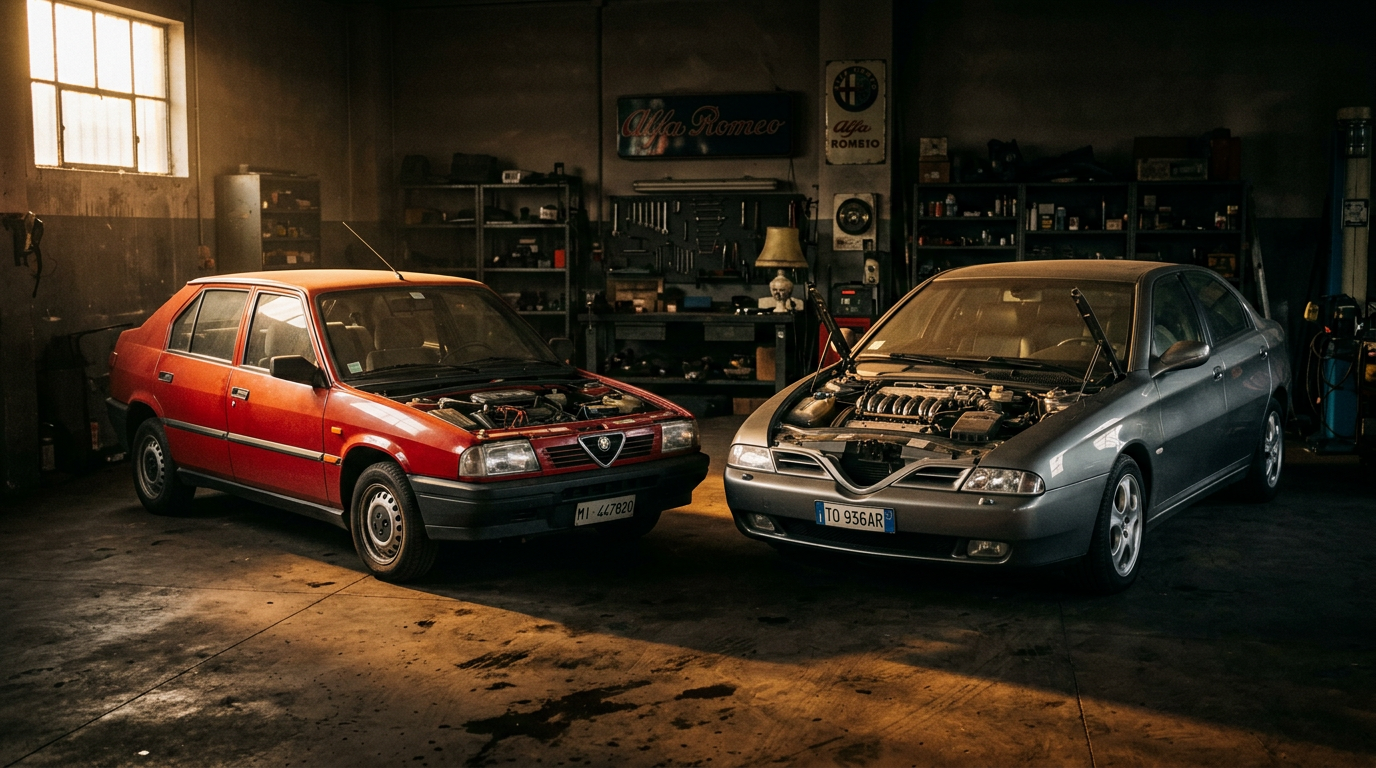
Cuore Sportivo — the "Souls and Hearts of Alfa Romeo" series, Storia V. The 1.4 8V boxer meets the Busso V6 3.0 — Pomigliano and Arese in one garage.
July 1994 · two ends of the peninsula, the two poles of Alfa's character.
There are two Alfas here, two eras, two cities. And two sounds that make this garage something more than a garage.
When I walk in of a morning — the 33 Imola first, then the 166 — I have the strange feeling that the air between them still remembers the last start-up. That something is trembling here, even though both engines are cold and the oil has drained to the sumps. This website begins with two cars. But really it begins with two voices.
Nord e Sud
The 1.4 boxer from my Thirty-Three was born in Pomigliano d'Arco, on the outskirts of Naples, in a factory the Italian government built to give the south work. It was a democratic engine — a Rudolf Hruska design, a working-class miracle meant to deliver carattere alfista for sensible money. Not a flagship. Everyday work. An engine for the mechanic in Naples, the lawyer in Milan, the student who wants his first Alfa.
The Busso V6 came into the world in Arese, near Milan, in an engineering studio where Giuseppe Busso drew it in 1979 for the flagship Alfa 6. It was not meant to be cheap. It was meant to be the best V6 in Europe. And for a quarter of a century it was. An engine not for everyone — for those who could afford it and who drove their own flagship themselves, rather than leaving it to a chauffeur.
It is no coincidence that one was born in the south and the other in the north. It is the whole history of Italy in two engines. My 33 Imola is one of the last built — July 1994, a few months before the boxer line in the Thirty-Three closed. My 166 was, in its segment, the beginning of the end — the last Alfa flagship with a Busso under the bonnet. I bought them in different years, but in the same spirit: to have both poles of Alfa Romeo's character in one garage.
Due architetture
The boxer has four cylinders laid out horizontally, two facing two, at 180°. A short crankshaft, three-bearing. Cast-iron block, aluminium heads, a single camshaft per head (SOHC), eight valves in total. It fires in the order 1-4-3-2, in short, even intervals. Electronic Magneti Marelli IAW injection — a control unit from Corbetta near Milan that replaced the carburettors in the second half of the 1980s. A simple design, proven across twenty years of this variant's production (1977–1997). Nothing superfluous. Everything repairable in a home garage.
The Busso is six cylinders in a 60° vee — a mathematically awkward angle, because it naturally leads to uneven firing. Busso solved it differently from the competition: he designed a crankshaft with offset crankpins that evened the firing intervals to a smooth 120°. Two camshafts per head (DOHC), twenty-four valves in total. Aluminium everywhere — block, heads, and the famous polished intake runners arching over the engine like organ pipes.
The boxer wants to be invisible in the chassis — low, flat, straight. The Busso wants to be seen under the bonnet — sculpture, theatre, spectacle. When you open the bonnet of the 166, you do it to show something to your guests. When you open the bonnet of the Imola, you do it to fix something.
Due voci
The 1.4 boxer does not scream the way its better-known brother, the 1.7 16V, does. It is not the worse for it — it is different. It starts to sing earlier. From 2,500 rpm you already hear that characteristic, gritty, metallic texture that is the signature of every Alfa Romeo boxer. You do not need to push it to know something unusual is working under the bonnet. Driving through town, between two and four thousand, it talks the whole time. It does not shout — it talks.
It is the voice of canzone napoletana — the folk song of the south, simple, repetitive, but impossible to mistake for anything else. There is no drama in it. There is honesty, repetition, and that particular warmth of a voice that knows who it is and does not try to be anyone else. Above five thousand the 1.4 changes — the grit gives way to a high, metallic note, as if someone tightened the octave a turn higher. But even then it does not try to be opera. It stays a song.
The Busso sounds like a Verdi aria. At low revs — a warm, deep, almost vibrating growl you feel in the chest, not the ears. Above four thousand something begins that Jeremy Clarkson once called one of the most beautiful sounds in motoring — not because of adjectives, but because the polished intake manifolds start to play like flutes while the exhaust adds the bass. It is no longer an engine. It is a choir.
The 1.4 boxer sings a single voice, all the time, effortlessly. The Busso plays six voices in harmony, but it needs a moment to warm up. One is folk music. The other is high art. Both are Italian in the same, precise sense: they treat sound as part of the design, not a side effect.
Cosa condividono
And yet, standing between them in the garage, I know they are siblings. Not technically — culturally.
Both refuse the same thing: being ordinary. Both were designed by people who believed the engine was part of a car's personality, not just its function. Both are interference engines whose timing belt decides their life — two belts in the boxer, one long belt over the vee in the Busso — and both punish an owner who skimps on maintenance. Both come from families that ended in the 1990s or the early 2000s, after which Alfa moved to engines from General Motors, then from Ferrari. There were, and will be, better engines by every measure you can put in a spreadsheet. But not by the one the spreadsheet does not know.
I was lucky to find them both just when they could still be saved, and not merely remembered.
Due motori, uno accanto all'altro
| Boxer 1.4 8V IE | Busso V6 3.0 24V | |
| Architecture | flat-4 · 180° | V6 · 60° |
| Displacement | 1,351 cm³ | 2,959 cm³ |
| Block | cast iron | aluminium |
| Head | aluminium | aluminium |
| Camshafts | SOHC (1 per head) | DOHC (2 per head) |
| Valves | 8 | 24 |
| Valvetrain | 2 toothed belts | 1 belt (long run) |
| Management | Magneti Marelli IAW | Bosch Motronic |
| Firing order | 1-4-3-2 | 1-4-2-5-3-6 |
| Firing interval | 180° | 120° (offset crank) |
| Crankshaft | three-bearing | four-bearing |
| Peak power | 88–90 PS @ 6,000 | 226 PS @ 6,300 |
| Torque | 118 Nm @ 4,000 | 270 Nm @ 5,000 |
| Forged in | Pomigliano d'Arco | Arese |
| Production | 1977–1997 | 1979–2005 |
| Voice | canzone napoletana | aria verdiana |
L'opera privata
On some Sundays I start both in the same order. The 33 first — because the 1.4 needs half a minute to settle its idle and announce itself in the garage with that calm but unmissable murmur the neighbours have learned by now. Then the 166 — the Busso lights with one heavy, deep breath, then drops to an idle so quiet you can hear the accessory belt find its rhythm.
For a moment both run together. It is perhaps ten seconds in which the garage turns into a private concert hall. A folk song from the south and an operatic aria from the north. Polifonia meccanica — two factories, two generations, one chord.
Then I shut down the 33. Then the 166. All that remains is the smell of petrol and heat.
And that, for me, is the whole definition of cuore sportivo — two hearts that beat differently, but to the same rhythm. One simpler, the other more elaborate, but both speaking the same language. The language of Alfa.
This story is a bridge between two sections of this site. More on the 33 Imola and the whole boxer family → Alfa Romeo 33. More on the V6 and the 166 → Alfa Romeo 166.
Cuore Sportivo — because numbers alone never made anyone fall in love with a car.
About this article
Two ends of the peninsula, the two poles of Alfa's character, one garage. On how the 1.4 boxer from the 33 Imola sounds next to the Busso V6 from the 166 — and why both speak the same language.