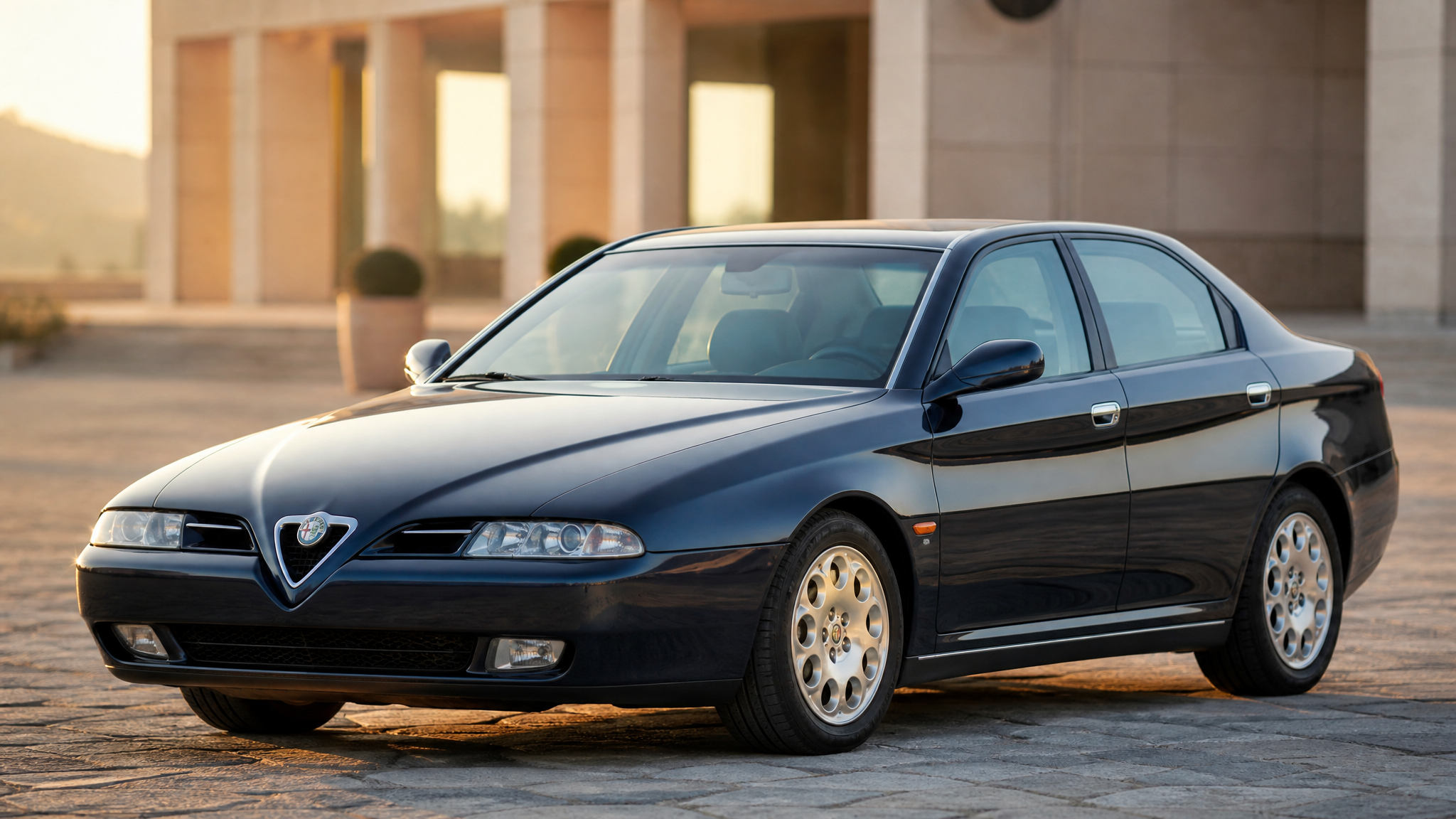
Storia VII — La genesi del 166
The real story begins in 1990, not 1998
Arese — Turin · eight years of engineering reflection before the six-hundredth test kilometre
In the previous Storia (Il grande incompiuto) I described the 166 from the market side — a car that arrived four years too late, lost the segment to its German rivals, sold fewer than 100,000 units. That was the story of a commercial failure. Now I'll tell you what happened during those four years of delay from the engineering side. Because that is an entirely different story — and a far more instructive one.
Progetto RT
Alfa Romeo began thinking about a successor to the 164 as early as around 1990, when the 164 itself had been on the market for only three years. The first concept was pragmatic: RT — Restyling Totale. An entirely new body on the existing Tipo Four platform (the same one the 164 shared with the Fiat Croma, Lancia Thema and Saab 9000). Old mechanicals, new skin. The project was given the internal code: 934/935.
Two firms were invited to the design competition: Pininfarina (which had designed the 164 and had every right to continue) and Centro Stile Alfa Romeo under the direction of the newly hired Walter de Silva. To the surprise of many — because Pininfarina was then an untouchable institution in Turin — the Centro Stile proposal won.
And this is where the problem begins.
Il momento Cantarella
When de Silva's team finished the body design, the production calendar began to slip. A year, two years, more. Paolo Cantarella — then head of Fiat Group's automotive division, promoted in 1996 to CEO of the entire Group — saw the problem the others preferred to ignore: if the 166 reached showrooms in 1997 or 1998 on the ten-year-old 164 platform, it would be archaic from day one. The German competition had had completely new generations since 1994 — Audi A6 C4, BMW E39, Mercedes W210. All on their own new platforms.
Cantarella made a decision that was bold by the Fiat standards of the time. He scrapped project 934. He ordered a fresh start. New project code: 936. New platform: Tipo E, the very one Lancia Kappa was just finishing developing (launched August 1994).
It was a decision that cost Alfa two additional years of development and billions of lire. But without it, the 166 would not have stood a chance even at the niche existence it ultimately achieved.
L'ispirazione di Egger
The starting point for the new design was not the Kappa. It was not the 164. It was a coupe rendering that a young Italian Alfa designer — Wolfgang Egger — had drawn in his spare time. The rendering showed coupe proportions, a long bonnet, a falling roofline. De Silva showed it to Cantarella. Cantarella said: “Scale it up to flagship size.”
Egger, whom Walter de Silva would later call “the most Italian German I know”, did exactly that. The coupe rendering was scaled to E-segment saloon dimensions — 4.72 metres long, 1.81 metres wide. The proportions were preserved: long bonnet, set-back cabin, low profile, roofline falling to the C-pillar. One characteristic detail the designer refused to drop from the final version was also kept: the narrow, closely set headlights and the small, tapered Scudetto. It was a design decision that stirred controversy in showrooms throughout the entire production run. But it was not a mistake. It was a deliberate move away from the conservative aesthetic of the German flagships.
La sospensione — dove Alfa dice davvero „no” a Lancia
But the real engineering work happened beneath the skin, not in it. Because here is the crux: Alfa did not accept the Lancia Kappa's suspension as it was. At the front the Kappa had MacPherson struts — a cheap, popular solution, sensible for an E-segment car with comfort ambitions. Not for Alfa.
Alfa's engineers — under the supervision of Centro Ricerche Fiat in Orbassano — redesigned the entire front end from scratch: high-mounted quadrilatero, double wishbones, geometry chosen so that the outer wheel in a corner maintains the optimal camber angle relative to the road. At the rear — a multilink with five arms, deliberately designed so that the rear wheels steer minimally in counter-phase to the fronts in a corner. The effect: the 166 turns in faster than its 1.5-tonne mass and front-wheel drive should allow.
The Kappa does not have this. The Kappa is Lancia's comfortable flagship. The 166 is an Alfa that happens to share a platform with the Kappa — not the other way round.
That difference then shows up in every comparison test from 1998 to 2005. The Kappa and the 166 have the same wheelbase, the same length, similar engines (the Kappa also had the Busso V6 3.0). But they drive like two different cars. Because they are two different cars. All they share is the floor.
Cosa significa questo
The first narrative you hear about the 166 on alfisti forums goes like this: “an overhyped Lancia Kappa with an Alfa badge.” It is a historical falsehood, and now we can say why. The 166 cost Fiat more than the Kappa, because Alfa refused most of the Kappa's mechanicals and designed it anew. That engineering decision was a luxury Alfa Lancia Industriale — and later Fiat Auto — chose against financial calculation. The commercial results showed it was the wrong decision in market terms. For today's collector, that is precisely why the 166 is worth having.
Because beneath that showroom-difficult design and that Kappa-shared chassis lies a car in which the Italians did everything to not build a second Lancia. They built the third Alfa flagship of the Busso era — after the 6 and the 164. The last one. This very one.
And that is the proper beginning of the story I tell in Il grande incompiuto.
La genesi del progetto 936 — cronologia
| Year | Event |
| 1990 | First concept — Progetto RT (Restyling Totale) on the Tipo Four platform. Internal coding: 934/935. Design competition: Pininfarina vs Centro Stile Alfa Romeo. |
| ~1992 | Centro Stile under Walter de Silva wins. Development of project 934 continues. |
| ~1994 | Paolo Cantarella (head of Fiat Auto) scraps project 934. Decision to restart on the new Tipo E platform. New project code: 936. |
| 1994 | Launch of the Lancia Kappa (August) on the Tipo E platform. Alfa 166 co-developed, but with radical suspension modification. |
| 1996 | Cantarella promoted to CEO of the entire Fiat Group. Start of 166 production (Rivalta, Turin). |
| 1998 | Market launch of the Alfa Romeo 166 — eight years after the first concept. |
This story is the engineering genesis of a project whose market history I tell separately. More on the 166 from the commercial side → Storia VI: Il grande incompiuto. More on the 166's engines → Il Busso.
About this article
Eight years of engineering reflection before the six-hundredth test kilometre. The story of project RT, Paolo Cantarella's decision, Wolfgang Egger's rendering, and why Alfa Romeo refused most of the Lancia Kappa's suspension.