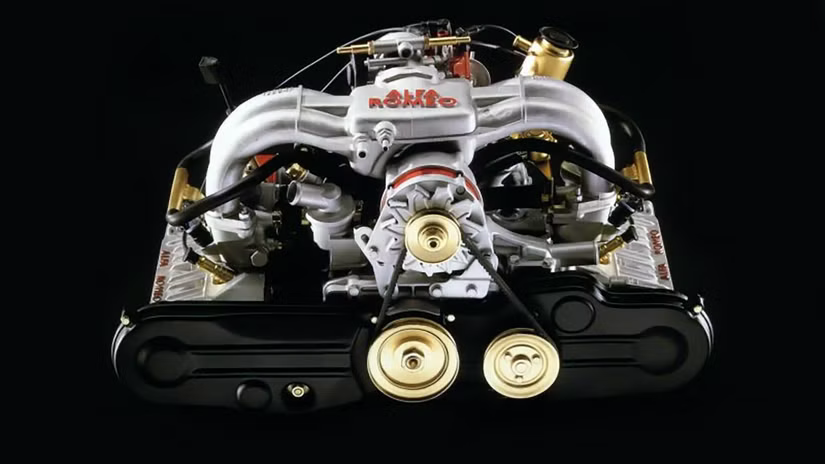
Storia III — La famiglia: The Alfa Romeo Boxer Family (1971–1997)
Twenty-six years, six displacements, two factories — from Portello 1940 to the Twin Spark of 1997
By Admin
Cuore Sportivo — the “Souls and Hearts of Alfa Romeo” series, part III. Pomigliano d'Arco – Arese · twenty-six years, six displacements, two factories
The 1.7 16V boxer did not fall from the sky. It was the last, most developed descendant of a family that, across a quarter-century of production, travelled the full road from a humble carburetted 1186 cm³, through every variant of the Alfasud and the Thirty-Three, to the sporting sixteen-valve unit with Bosch injection. So before I tell the story of the finale in Storia IV, a moment is owed to each member of the family — and to what came before it.
Prima dell'Alfasud
The boxer was nothing new to Alfa in the 1970s. As early as 1940, Portello built a twelve-cylinder boxer of 1.5 litres with supercharging, for the Grand Prix Formula car Tipo 512. The war froze the project, but the engineering DNA — cylinders facing one another, horizontally, for a low centre of gravity — remained in the company's memory for thirty years.
When, in 1968, Rudolf Hruschka (as they spelled his name at Portello) began to draw the mechanicals for a car that was to be called the Alfasud, he was returning to a native tradition. He was not inventing it.
L'anatomia della famiglia
Every Alfa Romeo boxer of this family shares a common anatomy: a cast-iron monoblock with an opening at the bottom for the crankshaft (three-bearing — not five, as is so often mistakenly written), two separate aluminium heads, liquid cooling, and — from the very beginning — two separate toothed belts, one per head. That last trait comes from physics: in a boxer the heads are separated by the cylinder spacing, so a single belt could never drive both.
Fuelling evolved: the first versions had one or two twin-choke carburettors; only in 1989 did Alfa move to electronic injection (Bosch Motronic or Magneti Marelli), chiefly to meet the new emissions standards.
La cronologia — sei cilindrate, ventisei anni
1971 — Debut in the Alfasud. 1186 cm³, 80 × 59 mm, 63–69 PS. The family's base version.
1977 — A new variant by lengthening the stroke to 67.2 mm: 1351 cm³, 76–90 PS. This was the engine that, in the 1983 33, was badged “1.3", and from 1990 — as “1.4". Marketing, not engineering.
1978 — The largest version of the first stage: 1490 cm³, 84 × 67.2 mm, 85–105 PS, with two twin-choke carburettors. This engine became the family's most popular variant and was built until the end.
1983 — The Alfasud ends production; its successor, the Alfa 33, inherits the entire boxer range.
1986 — The last carburetted unit: 1712 cm³, 87 × 72 mm, 105 PS in base form, 118 PS in the 33 Quadrifoglio Verde. It is the same engine that, three years later, would receive a 16-valve head.
1989 — The family's finale in the 33: 1712 cm³ 16V with Bosch injection, twin-cam heads and 137 PS. Its own story is Storia IV.
1994 — The last debut, but no longer in the 33. A new 1596 cm³ variant of 103 PS goes exclusively to the Alfa 145/146. The Thirty-Three never received it.
1997 — The end. Alfa Romeo — already under Fiat — closes the boxer family and switches the 145/146 to transverse inline Twin Spark engines. It is the end of forty-six years of thinking about the car through the prism of a flat engine.
Il cugino imbarazzante — Arna
There is an episode in this history that alfisti today prefer not to mention, but which technically belongs to the family. Between 1983 and 1987 Alfa built, jointly with Nissan, the Alfa Romeo Arna (and its twin, the Nissan Cherry Europa) — a compact hatchback with a Japanese body and Italian mechanicals. Under the Arna's bonnet worked precisely the Alfasud boxer, in several displacements. The car sold poorly, the quality was — to put it gently — below the standards of both manufacturers, and the whole escapade passed into history as one of those moments when Alfa tried to do something it was not built to do.
But the Arna's boxer is a boxer of this family. It is worth knowing.
Il diesel outsider — 1.8 TD
There was one engine in the 33 that was not a boxer and did not come from Pomigliano. The VM Motori HR 392 — a three-cylinder turbodiesel of 1779 cm³, built in Cento near Ferrara by a firm that had built its tradition on marine engines. SOHC, cast-iron block, aluminium head, a KKK 14 turbo, 74 PS (Serie 2) or 84 PS (Serie 3 after the facelift). Bosch VE indirect injection, a balancer shaft.
Around 6,500 were sold. Culturally it does not belong to the boxer family — technically it belongs to the history of the Thirty-Three. It has to be mentioned, though every alfista knows this is not the engine for which one buys a 33.
La famiglia dei motori boxer Alfa Romeo (1971–1997)
| cm³ | Production | Power | Application | Notes |
| 1,186 | 1971–1995 | 63–69 PS | Alfasud · Arna · 33 · N. Cherry E. | Family debut |
| 1,351 | 1977–1997 | 76–90 PS | Alfasud · 33 · 145 · 146 · Arna | Longest in production (badge: 1.3 → 1.4) |
| 1,490 | 1978–1995 | 85–105 PS | Alfasud · Arna · 33 | Most popular |
| 1,596 | 1994–1997 | 103 PS | 145 · 146 | Last debut · never in the 33 |
| 1,712 8V | 1986–1995 | 105–118 PS | Alfasud Sprint · 33 QV | End of the carburettor era |
| 1,712 16V | 1989–1997 | 137 PS | 33 QV 16V · P4 · 145 · 146 | Family finale (Bosch Motronic) |
A separate record: the 1.8 TD (1779 cm³, VM Motori HR 392, inline-3) — the only non-boxer in the 33 range, 1986–1994, 74–84 PS.
Cosa lega la famiglia
The diesel from Cento aside — all these engines share one DNA: Hruschka's 1968 concept, built on Portello's memory of 1940. The same philosophy of a low centre of gravity, the same cast-iron monoblock, the same two belts, the same three-bearing lightness of construction that makes the Alfa boxer a dozen kilograms lighter than a comparable inline-four.
It is a rare thing in the motor industry — a design that survived intact for a quarter of a century and four changes of company ownership (from the state-owned IRI, through Alfa-Lancia Industriale, to Fiat). Not because it was perfect. Because it was good — and because everyone at Portello knew that if they let it go, they would lose something they could never get back.
In 1997 they lost it. And this is the right moment to remember that.
To hear the finale of this family → Storia IV: Il boxer che canta.
Cuore Sportivo — because numbers alone never made anyone fall in love with a car.
About this article
Before the finale, a moment is owed to each member of the Pomigliano boxer family — including its one intruder, the 1.8 TD diesel from Cento.