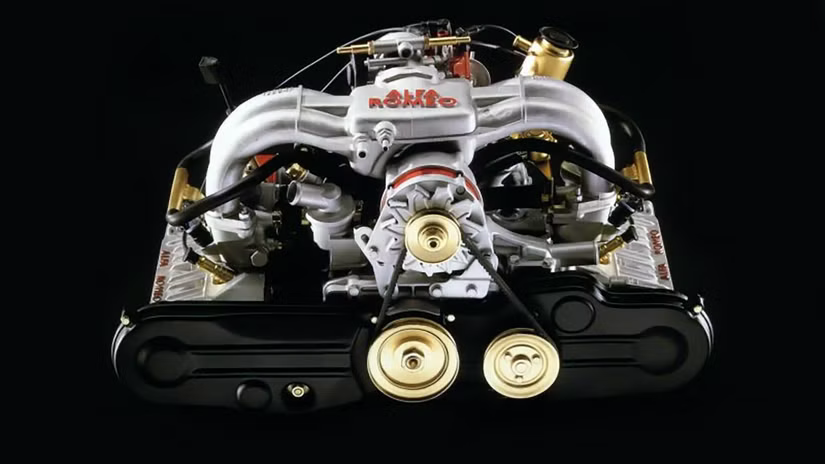
Il boxer che canta: The Story of the Alfa Romeo 33 1.7 16V
The last descendant of Hruska’s line — from the Alfasud to the Thirty-Three QV
By Admin
Cuore Sportivo — the “Souls and Hearts of Alfa Romeo” series, part IV. Napoli – Pomigliano d’Arco · 1989–1994
There are engines that work. And there are engines that sing. The 1.7 16V boxer from the Alfa 33 belongs to the second kind — and that is not romantic exaggeration but a consequence of geometry, firing order and a certain way of thinking about a car that began in Naples in the 1960s.
L’eredità di Hruska
To understand why a flat-four ended up under the bonnet of an ordinary hatchback like the Thirty-Three, you have to go back to 1967 and to one name: Rudolf Hruska. A Viennese Austrian who had worked at Porsche and Fiat, he returned to Alfa with a brief that sounded like a paradox — to design a small, cheap, accessible car for the Italian south that would still have carattere alfista. The answer was the Alfasud and its drivetrain: front-wheel drive, with a longitudinally mounted flat-four engine sitting low behind the axle.
The choice of a boxer was no whim. Cylinders splayed at 180° allowed the centre of gravity to drop almost to axle height, shortened the front of the body and produced a natural balance of forces — two pistons moving toward each other, two away, at the same instant. The car drove unlike anything else Italy offered in that segment. This philosophy outlived the Alfasud and passed as an inheritance to the Thirty-Three in 1983. The last and most developed version of the line was the 1.7 boxer with a sixteen-valve head — an engine whose story closes an era.
L’evoluzione a sedici valvole
Introduced to the sporting 33 variants in 1989 (Quadrifoglio Verde and Permanent 4), the 1.7 16V was an evolution, not a revolution. The block stayed familiar — cast iron, with an aluminium head, displacing 1,712 cm³ from an 87 mm bore and a 72 mm stroke. A “square” design, favouring high revs over low-end torque. What was new was up top: two overhead camshafts, four valves per cylinder, sixteen in total.
The effect was pure physics. Four valves per cylinder mean greater total flow area, less mass per individual valve, and a higher engine speed at which the head can still breathe. An electronic, multi-sensor control unit appeared — Bosch Motronic in successive variants — which finally reconciled Alfa’s sporting character with the growing emissions demands of the 1990s. The catalytic converter took a few horses, but it did not take the voice.
The valvetrain required two separate toothed belts — one per head — and that is one of those details that still makes classic-car mechanics breathe a little deeper before every change. Hydraulic tappets freed the owner from valve adjustment, but nothing freed him from watching the timing. This is an interference engine — a late belt change does not end expensively, it ends definitively.
Il carattere
Declared power, depending on version and the presence of a catalyst, sat in the range of 129–137 PS at 6,500 rpm, with 161 Nm arriving only at 4,600 rpm. Figures that raise a smile today — until you sit in the cabin and turn the key.
The Alfa boxer does not sound like a Subaru. It has none of that characteristic, breathless burble that comes in an Impreza from unequal-length headers. It has something else: a dry, gritty, metallic rasp that above four thousand turns into a scream. It is the signature by which an alfista recognises the car before it even appears round the corner.
In the way it drives, the geometry makes itself felt. A low, flat engine sitting low in the chassis lets the 33 turn in with a lightness no average hatchback of that decade could match. The body barely rolls. The car weighs under 1,000 kilograms and has a three-bearing crankshaft that gives the block surprising durability at high revs.
Technical data
| Configuration | 4 opposed cylinders (boxer), 180° |
| Valvetrain | DOHC · 16 valves · toothed belts (2) |
| Block/head | cast iron / aluminium |
| Displacement | 1,712 cm³ |
| Bore × stroke | 87.0 × 72.0 mm |
| Fuelling | Bosch Motronic (MP3.1 / ML4.1) |
| Power | 129–137 PS @ 6,500 rpm |
| Torque | 161 Nm @ 4,600 rpm |
| Crankshaft | three-bearing |
| Applications | Alfa Romeo 33 QV 16V, P4 · 145/146 (1994–1997) |
La realtà del garage
You can write about the 16V boxer at length and beautifully, but the truth also looks like this: it is an engine the designers built for the chassis, not for the mechanic. The heads sit wide, almost touching the inner wings. Changing the plugs is an exercise in humility. The valve-cover gasket — a few hours, two bruises and a word I won’t repeat. There are two timing belts, both requiring precise synchronisation, and it forgives no shortcuts.
At the same time — and this is the paradox of the engine — the reward for patience is a very durable unit. A three-bearing crank, a cast-iron block, conservative bottom-end geometry. If the oil is fresh, the timing on schedule and the cooling system tight, these boxers pass 300,000 kilometres without being opened. It is an engine that rewards obsessive owners. There is no other way.
La fine di un’era
The sixteen-valve version was the last chord. After it, Alfa Romeo — already under Fiat — closed the boxer project and moved entirely to inline four-cylinder Twin Spark engines. They were more modern, cheaper to build, easier to service. They were also — it must be said plainly — technically better in almost every respect written about in a brochure.
But they did not sound like this.
The 1.7 16V boxer is not an engine that won the war of specification sheets. It is an engine that closes a certain way of thinking about a car — one in which the mechanical architecture was meant to have character, not just parameters. The last descendant of a line that began with Hruska’s idea that the sud deserved more than an ordinary motor under the bonnet.
In the 33 QV 16V that idea reached the finish. Quietly, decisively, and with that characteristic metallic scream at four thousand revs.
Il cuore non invecchia mai.
Cuore Sportivo — because numbers alone never made anyone fall in love with a car.
About this article
There are engines that work, and engines that sing. The 1.7 16V boxer of the Alfa 33 belongs to the second kind — and it is geometry, not romance, that makes it so.