Busso V6: Biography of the Engine That Gave Alfa Romeo Its Soul
From the 1979 Alfa 6 to the last unit of 31 December 2005 — the complete story of the Violin of Arese
By Admin
Cuore Sportivo — the “Souls and Hearts of Alfa Romeo” series. From the 1979 Alfa 6 to the very last unit built on 31 December 2005 — the complete story of the Violin of Arese.
We opened the series with a duel in which the Violin of Arese fell silent, ceding its place to an American 3.2 JTS. But to really understand what we lost that day, you have to go back a quarter of a century — to the day this instrument first began to play. This is not the story of a single car. It is the biography of an engine.
Birth (1979)
Giuseppe Busso was responsible for the mechanicals of almost every post-war road-going Alfa — from the 1900, through the Giulietta and Giulia, to the Alfetta. When he retired in 1977, his life’s work was still waiting to be born. A prototype of the six-cylinder unit had existed since 1968, but it did not reach a production car until eleven years later. Although he had formally left, Busso never handed the project to other hands — he saw it through to the end.
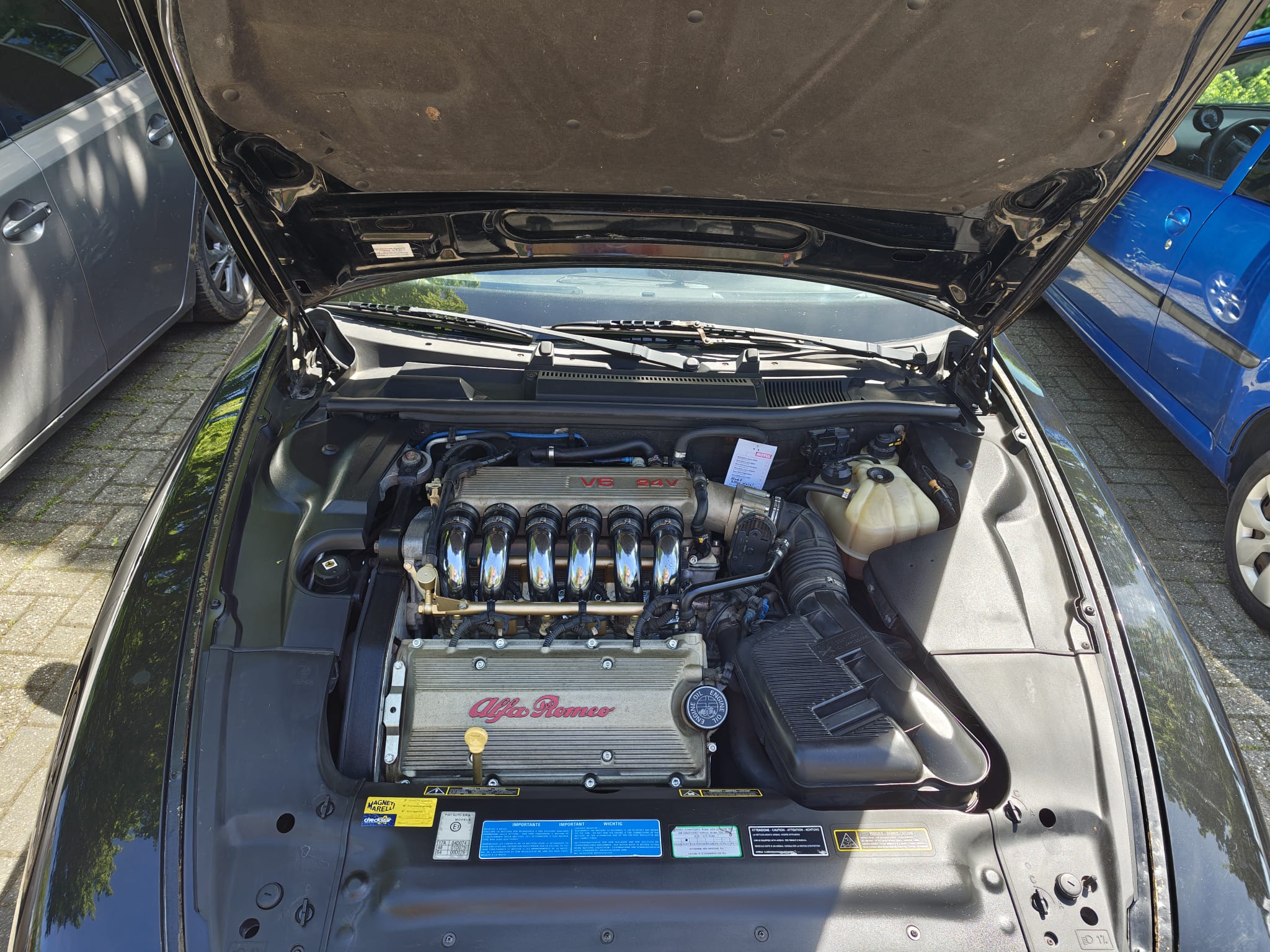
The engine debuted in 1979 under the bonnet of the dignified, if not especially loved, Alfa 6. It was an all-aluminium V6 with a 60° bank angle, 2.5 litres of displacement, a single overhead camshaft per head (SOHC) and two valves per cylinder. Its short-stroke architecture reduced friction and encouraged high revs, while six polished, chromed intake runners immediately became the visual signature of the design.
A quarter-century of evolution
Over the following decades the engine changed constantly, chasing ever-stricter emissions limits while growing in strength. The original carburettor gave way to Bosch L-Jetronic injection, and later to Motronic systems. The family grew in both directions: from turbocharged 2.0 versions (created as a “workaround” to the Italian tax on displacements above two litres) all the way to the mighty naturally aspirated 3.2.
The real technical leap came in 1993 with the 24-valve, twin-cam (DOHC) heads. That change radically improved cylinder filling and high-rpm performance. Along the way the Busso brought a whole gallery of models to life: the GTV6, 75, 164, 916 Spider and GTV, 156 and the flagship 166.
The apogee: the “Bussone” (2002)
The final and most aggressive factory evolution arrived in 2002 with the 147 GTA and 156 GTA (and later the GT). Enlarged to 3,179 cm³ (93 mm × 78 mm), the engine earned the nickname “Bussone” — the Great Busso. Under the bonnet it looked like an exhibit: silver cam covers with the Alfa Romeo name in red, crowning six polished, chromed intake runners.
It was the peak of the Italian school of engineering: 24 valves, four camshafts, a 10.5:1 compression ratio, sodium-filled exhaust valves carrying away excess heat, and Bosch Motronic ME7.3.1 management with an electronic throttle. The result was 250 PS (247 bhp) at 6,200 rpm and 300 Nm at 4,800 rpm, with a cut-out around 7,000. To cope with the loads of the larger capacity, the engineers added an oil cooler, a strengthened crankshaft and dedicated pistons. Unlike today’s turbocharged units that pull from low down, the “Bussone” lived on high revs — linear, building and building, all the way to the red line. The sprint to 100 km/h took a little over six seconds, and top speed reached around 250 km/h.
In a slightly softer state of tune (about 240 PS) the same engine also powered the Alfa GT and the flagship 166 saloon, and in Phase 3 guise it found its way beneath the bonnets of the Spider and GTV 916 — the last cars ever allowed to carry the true Violin of Arese.
The voice
Yet it was not the numbers that made it a legend. “The Violin of Arese” is no marketing metaphor but a description of a sound: a deep, metallic growl at low revs turning into a piercing, almost mechanical scream under load. The character of that sound comes from the architecture of the sixty-degree V6 itself and from the design of the intake system with those chromed runners — a voice no turbocharged block can reproduce. It is no accident that specialists and tuners today fabricate dedicated manifolds purely to amplify that song rather than smother it.
Living with a Busso
Beauty had its price, paid in the workshop. The Busso is driven by a rubber timing belt with a hydraulic tensioner that demands absolutely regular replacement — neglect ends in valves meeting pistons and a full rebuild. Packing a large V6 into the engine bay of a compact 147 or 156 means that even routine jobs, such as changing the plugs on the rear head, can require extensive disassembly, subframe drop included.
Then there is the famous GTA sin: from the factory the car had no limited-slip differential, so 250 PS reached the front wheels without any discipline. That is why fitting a Torsen unit (familiar from the Q2 system) is one of the most frequently recommended modifications today.
The end (December 2005)
All good things come to an end. Even though the last iteration met Euro 4 and even Cosworth showed interest in production, Alfa decided to close the chapter. The final batch of Busso engines left the Arese factory on 31 December 2005, after more than a quarter of a century of uninterrupted production.
What came afterwards we described in the first episode of the series: an American 3.2 JTS block from the GM High Feature family, and many years later a turbocharged V6 developed with Ferrari engineers. Both were good. Neither was one hundred percent Italian any more. The Busso remains Alfa Romeo’s last authentic, entirely in-house V6.
The finale
And then history wrote an ending too theatrical even for an Italian film. On 3 January 2006, just three days after his last engine came off the line, Giuseppe Busso died in Arese at the age of 92. A year earlier he had managed to publish an autobiography with a title that now sounds like a prophecy: “Nel cuore dell’Alfa” — “In the heart of the Alfa.”
At his funeral, as the coffin was carried from the church, hundreds of Alfa owners gathered outside revved their engines all at once. It was the last concert of the Violin of Arese — a farewell chord, played by the instrument itself for the man who built it.
Busso V6 3.2 “Bussone” — technical data
| Displacement | 3,179 cm³ (93 mm × 78 mm) |
| Layout | V6, 60°, aluminium block and heads |
| Valvetrain | DOHC, 24 valves, belt; sodium-filled exhaust valves |
| Compression | 10.5:1 |
| Management | Bosch Motronic ME7.3.1, electronic throttle |
| Power | 250 PS (184 kW / 247 bhp) at 6,200 rpm |
| Torque | 300 Nm at 4,800 rpm |
| Cut-out | approx. 7,000 rpm |
| 0–100 km/h | just over 6 s |
| Top speed | approx. 250 km/h |
| Models | 147 GTA, 156 GTA (250 PS); GT, 166, Spider/GTV 916 Phase 3 (approx. 240 PS) |
Milestones
- 1968 — first prototype
- 1979 — debut in the Alfa 6 (2.5 SOHC, 12 valves)
- 1993 — 24-valve DOHC heads
- 2002 — the peak: 3.2 “Bussone” (147 GTA / 156 GTA)
- 31.12.2005 — the last engine leaves Arese
- 03.01.2006 — Giuseppe Busso dies
Cuore Sportivo — because numbers alone never made anyone fall in love with a car.
About this article
This is not the story of a single car. It is the biography of an engine — the last authentic, entirely in-house V6 Alfa Romeo ever built.