The Car I Almost Forgot I Needed
How an imperfect Italian sedan brought me back to myself
By Admin
A personal story by Luc — May 2026
Some people buy a car with their head.
Some buy one with their heart.
I thought I was doing both.
Looking back, I think my hands knew before either of them did.
A part of me I left behind
Between 2014 and 2023, something in me went quiet. Not all at once. Gradually, the way a fire doesn't go out in a single moment — it just slowly stops being fed.
I had responsibilities. A marriage. A life that looked right from the outside. And somewhere in all of that, I stopped doing the things that made me feel like myself.
One of those things was driving.
Not commuting. Not getting from A to B. I mean driving — the kind where you feel the road, where the car talks back to you, where pressing the accelerator a little harder than necessary is a small, private act of joy.
My first Alfa Romeo was a 1994 Alfa Romeo 33 1.4 IE Imola — a lightweight boxer-engined car with 90 horsepower that had absolutely no business being as exciting as it was. I drove it on track days. I fell in love with the Alfisti community through it. My then-wife was embarrassed by it.
I kept it anyway. Or at least, I thought I did.
What I actually did was leave it at my parents' house. And then, for nine years, I walked around it every time I visited. Not because I forgot it was there. But because I couldn't face what it represented — a version of me I wasn't sure still existed.
The fear of going back to something you loved, and finding it gone, is sometimes stronger than the fear of losing it in the first place.
The years in between
After the 33, I didn't stop driving. I just stopped feeling it.
There was a Fiat Seicento — the Michael Schumacher limited edition, yellow, with the kind of holes in it that only Italian city cars of a certain age can produce with such creativity. It had spirit, in its own small way. Schumacher was a god in those years, and buying his edition of a tiny Fiat was perhaps my way of keeping one foot in the world of passion without fully committing to it.
Then came a Fiat 600 in 2006, which I still have. Reliable. Practical. A car that does exactly what you ask of it and nothing more. My neighbour once looked at my cars and said simply: "Italian cars…" — with a smile that contained an entire philosophy.
He wasn't wrong.
What I understand now, looking back, is that during those years I thought I was being responsible. Saving money. Making sensible choices. But what I was actually doing was saving money instead of living — not saving money in order to live.
I was economising on myself.
On the track in my 33, I was never the fastest. That was never the point. The point was the feeling — that thing you can't describe to someone who hasn't felt it. When I stopped driving cars that gave me that feeling, something went quiet. Not dramatically. Just slowly, the way a radio fades when you drive out of range.
I didn't notice until the signal came back.
The long way back
Before I found my way back to Alfa Romeo, I made a detour through America.
I drove a Dodge Ram BigHorn 4x4 across the Pacific Northwest — roughly 2,300 miles from Seattle via Cannon Beach down toward California and back. It was magnificent in its own way: enormous torque, effortless highway presence, the kind of machine that makes you feel like you own the road simply by existing on it.
But it wasn't mine. Not really.
I had to get out and check distances when parking. The fuel stops were an event in themselves. Someone on a parking lot once assumed it was my truck — and maybe it suited me, visually. But it happened exactly once that week. Something was missing.
When I came back to the Netherlands, the rational plan was a Fiat Qubo. Practical. Economical. Sensible. The kind of car you buy when you've decided to stop asking too much from life.
I almost bought it.
And then I didn't.
The car that found me
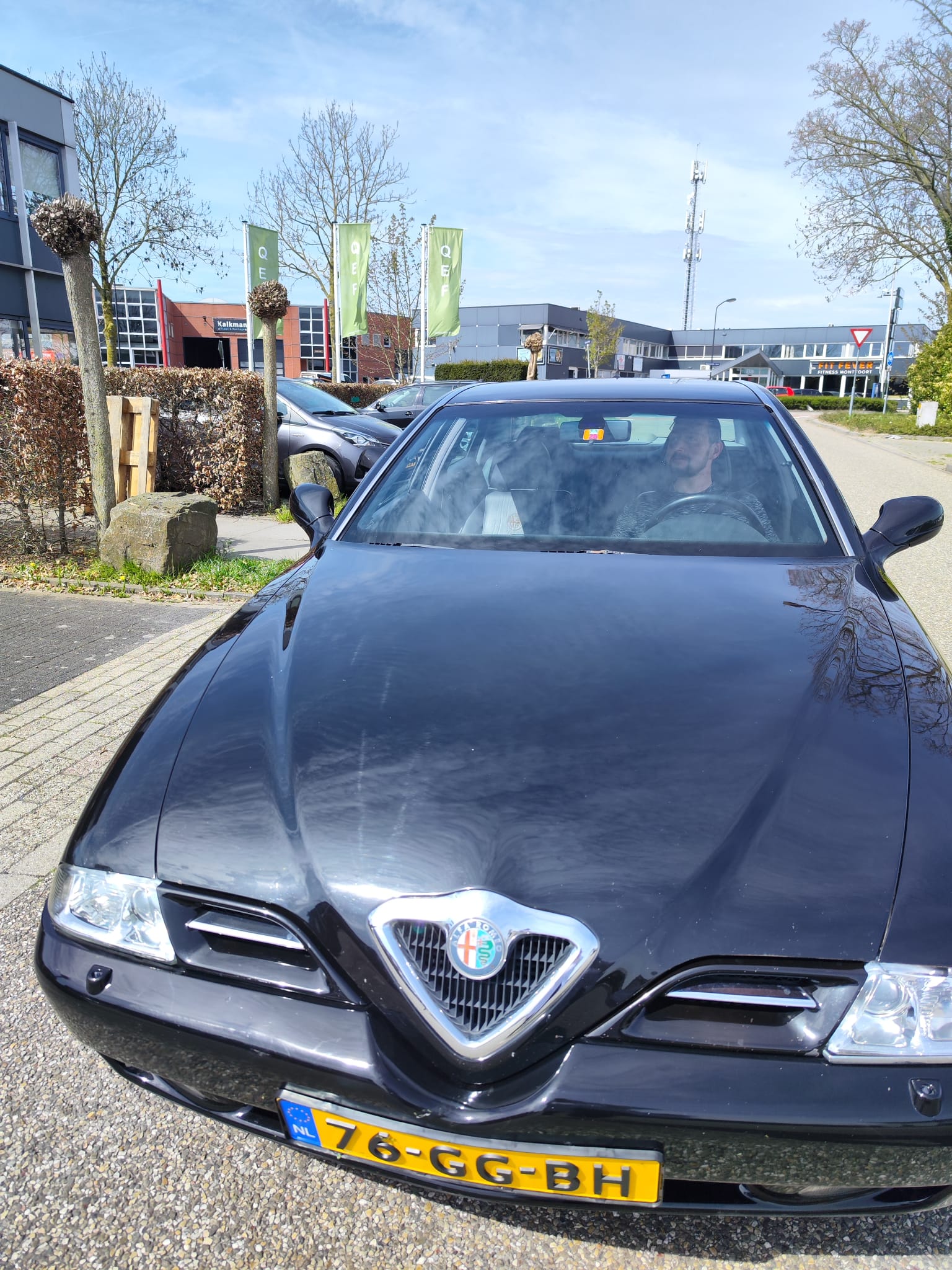
Instead, I started looking for an Alfa Romeo 166 with a Dutch registration — specifically the 3.0 V6 Busso. Not for any single logical reason. For a hundred small reasons that together added up to something I couldn't argue with.
The 166 I found was a 2000 model, Progression trim, black, with over 280,000 kilometres on the clock and a history that would reveal itself slowly and expensively. Cooling system contamination from a previous head gasket leak. A Climatronic that gave warm air when you asked for cold. A gearbox that shifted nervously. Exhaust rust. Aftermarket rear lights. A warning lamp that still blinks for reasons I haven't fully solved.
On paper, it was a questionable decision.
In practice, every time I press the accelerator a little harder than I need to, I feel something I had almost forgotten existed.
That small, private act of joy.
What the Busso taught me
Everyone talks about the Busso V6 as if it's something mystical. I used to think that was an exaggeration.
After two partial gearbox oil changes, a long drive toward Poland with the V6 settling into a quiet, sustained hum on the German Autobahn, and the moment I sat in the back seat while a friend drove — listening to the exhaust note from the outside, the way someone else hears your favourite song for the first time — I understood.
It's not about horsepower. It's not about 0–100 times.
It's about a machine that asks something of you. That gives back in proportion to what you put in. That doesn't filter out the experience of driving in order to make it easier — it amplifies it.
In the first month, I drove over 6,500 kilometres with this car. The more kilometres I made, the better I understood it. And the more it surprised me.
The community I didn't expect
I bought the car alone. I didn't stay alone for long.
At Cars and Coffee in Houten on the 9th of May 2026, seven Alfa Romeo 166s gathered in the same car park. Mine was not the most beautiful of the group. But I belonged there. I spoke with other owners, listened to their stories, and discovered how alive the passion for this model still is.
Within days I was part of a WhatsApp group called Alfa 166 Club. I met Robert, who has been keeping the community together for years — quietly, without a title, out of pure love for the car. Arnold, who offered to drive together to Zandvoort. Ferry, who drove from another city to pick up parts I'd found for his Brera. Peter, who described the sound of a Busso V6 the way a musician talks about an instrument he can never replace.
These are not car people in the way the stereotype suggests. They are people who chose something difficult and impractical and alive, at a time when the world keeps offering easier alternatives.
That choice, I've come to understand, is what connects us.
The 33 is still there
My Alfa Romeo 33 Imola is still at my parents' house.
I still walk around it sometimes. The fear is still there — that strange, wordless fear of returning to something you loved and finding the feeling gone.
But something has shifted.
Buying the 166 was not just buying a car. It was a small act of remembering. A decision to stop waiting for the perfect moment, the right conditions, the safer version of life that never quite arrives.
The list of things to fix on the 166 keeps growing. But every time I press that accelerator, the list stops mattering for a moment.
That moment is enough.
Savings matter. Of course they do. But you only live once. And there is a difference between saving money and saving it instead of yourself.
Why this site exists
Cuore Sportivo — sporting heart — was Alfa Romeo's promise. Not just about speed. About aliveness. About choosing a machine with a soul over a machine with convenience features.
In a world that is automating every experience, choosing something mechanical and imperfect and demanding is almost a political act.
Nobody has ever fallen in love with a car because of its parking assistance.
But people fall in love with Alfa Romeos all the time — even when, especially when, it makes no logical sense.
This site is for those people.
Luc — May 2026
Alfa Romeo 166 3.0 V6 Busso Sportronic Progression, 2000, Nero, 280.000+ km