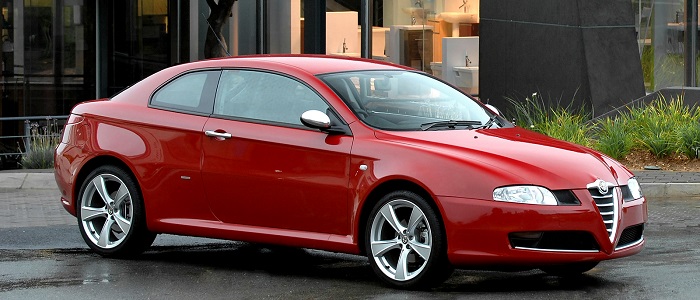
Five Seconds of Heresy: What If the Alfa GT Lost Its Busso?
Busso V6 versus a hypothetical 1750 TBi swap on the Nordschleife
By Admin
Cuore Sportivo — "Souls and Hearts of Alfa Romeo" series
Note: The car described is a purely hypothetical project. The results presented are based on a performance simulation of the Alfa GT 3.2 V6 after an engine swap to the 1750 TBi, taking into account lower mass, improved weight distribution, higher torque, and altered driving characteristics.
There is a moment in every Alfista’s mind that he will never admit to out loud. You are standing in the garage over your GT, wrench in hand, and in your thoughts — a completely sacrilegious idea. What if the Busso were gone from under that bonnet? What if, instead of six cylinders singing toward the redline, you dropped in a modern, turbocharged four-cylinder? Faster. Lighter. More effective.
It is heresy. But heresies are tempting precisely because they make sense.
The Temptation
On paper, the swap defends itself. The 1750 TBi engine (1,742 cc), known from the aluminium block of the Alfa 4C, produces 240 hp at 5,750 rpm and — more importantly — a full 350 Nm available from just 2,000 rpm. The KKK K04 turbocharger and scavenging technology make it respond to the throttle almost like a large naturally aspirated engine, without the typical turbo lag.
But the real gain is not under the bonnet — it is ahead of the front axle. The lighter unit brings the kerb weight down to around 1,280 kg and completely changes the weight distribution compared to the V6 version, which pays for the same 240 hp with an additional 130 kilograms sitting mainly over the front wheels. Add a six-speed manual and a mechanical Torsen Q2 limited-slip differential, which turns those 350 Nm into traction rather than inside-wheel spin on corner exit.
The GT’s suspension — high double-wishbones at the front and a rear axle with its characteristic elastokinematics — was always the strongest card this car held. Take a few dozen kilograms off its nose, and you get a corner-carving instrument sharper than the designers ever intended.
What You Gain
Imagine the lap. At Flugplatz the lighter front end does not dive — it leads. The change of direction is instantaneous, without that microsecond of inertia you feel in the V6. Through Fuchsröhre, at over 230 km/h and violent load changes, the car remains composed where the heavier version would have you holding your breath.
The TBi’s greatest advantage, however, shows on exits from slow corners. Torque available from the bottom of the rev range lets you open the throttle earlier, while the Q2 pins the inside wheel to the tarmac instead of letting it spin in the void. The driving is effective, clean, almost surgical.
And right then, you start to miss something.
What You Lose
Because the Busso was never about effectiveness. The same 240 hp are born here only at 6,200 rpm, and around 300 Nm arrives at 4,800 — and that is the entire philosophy of this engine. It does not give you power; it leads you through it, linearly, higher and higher, to a place where the four-cylinder has long since given everything it had.
Through the technical sections of Hatzenbach, those 130 kg over the front axle do make you work harder. But on Döttinger Höhe, when the V6 pushes the GT to around 243 km/h, the cabin fills with that metallic song of six cylinders that no turbocharged block will ever replicate — and suddenly you stop caring that the TBi was a fraction quicker there. The turbocharged version reaches roughly 245 km/h at the end of the straight. The numbers are almost identical. The sensations are from a different planet.
Five Seconds
And now the punchline, the reason for all of this: on the Bridge-to-Gantry loop (approx. 20.6 km), the hypothetical GT 1750 TBi Q2 clocks approximately 9:12. The standard GT 3.2 V6 — approximately 9:17.
Five seconds.
All that heresy, all that sacrilege, dismantling a legend and pouring in an American-Italian turbo — to gain, over twenty kilometres of the Green Hell, as much time as it takes to change gear at a traffic light.
The Verdict
And here is the twist you did not expect: the TBi really does win. It is faster, it is easier, it is more effective. If the stopwatch were all that mattered, the wrench should already be in your hand.
But that is precisely why you should not do it. Those five seconds you would gain are five seconds of silence. The heresy is not that the four-cylinder loses — it is that it wins, and in doing so proves that the stopwatch was asking the wrong question all along. The Busso never answered the question “how fast.” It answered the question “what is it like.”
So you put the wrench down. Not because it cannot be done. Because you finally understand what you were really trying to undo.
Cuore Sportivo — because numbers alone never made anyone fall in love with a car.
About this article
You are standing in the garage over your GT, wrench in hand, and in your mind — a completely sacrilegious idea. What if the Busso were gone? Five seconds on the Nordschleife — that is the price of heresy.